
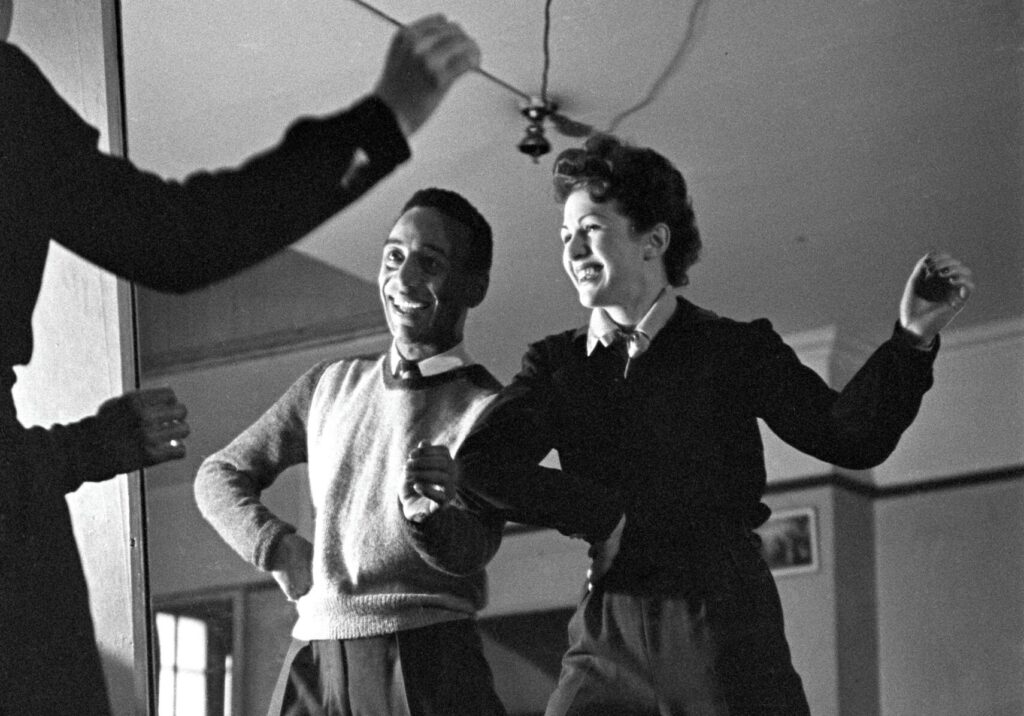
Buddy Bradley with Patricia Burke cr Kurt Hutton. Picture Post.via Getty Images
by Rachel Thomas, Communications Manager, The Frederick Ashton Foundation
In 1932, Frederick Ashton – not yet 30, and yet to become the defining choreographer of British ballet – began working alongside an African American dancer and choreographer whose name is now little known outside dance-history circles: Buddy Bradley. Though brief, their creative exchange offers a revealing glimpse of the young Ashton shaping his craft, experimenting and developing a curiosity for new forms of movement that would echo through later works.
Born in Clarkesville, Georgia, Bradley came up through the floor shows of Harlem’s Prohibition-era clubs and made his name staging dances on Broadway before settling in London. He was, in the language of the day, a ‘dance director’, but really something rarer. Author Maureen Footer, whose recent biography of Bradley, Feel the Floor, has renewed interest in the choreographer, characterises him as a ‘dance whisperer’: a gifted teacher who could break jazz movement down and transmit it to ballet- and ballroom-trained bodies. Yet, as a Black artist in working on Jazz Age Broadway, he was often left uncredited—prized for his talent while remaining at the margins of the productions he transformed. London’s West End, however, sought Bradley out, and gave him full credit. He coached stars such as Jessie Matthews and Jack Buchanan in a dance language characterised by relaxed, polyrhythmic movement, grounded use of weight and vernacular gesture, and also shaped dance numbers for the impresario C.B. Cochran.
It was through revues for producers like Cochran that Ashton and Bradley, who were less than a year apart in age, first met. After collaborations early in 1932 including Magic Nights – in which Ashton himself danced (or, as he later claimed, ‘faked’) a Bradley tap routine – Ashton brought Bradley into the more rarefied world of the Camargo Society, the subscription venture commissioning new work from a rising generation of choreographers and artists.
Going on to work together on further revues during the 1930s, Ashton and Bradley became friends, spending evenings in Bradley’s flat talking about dance along with Markova. But what, if anything, did they take from one another as choreographers?
At the May 2026 V&A symposium Celebrating a Century of British Ballet, Footer described Ashton and Bradley as young collaborators who inspired one another, each expanding the other’s sense of what was possible. From her perspective as a Bradley scholar, she suggests that he absorbed aspects of Ashton’s choreographic thinking, his staging becoming more spatially layered and balletic in conception, with greater attention to ensemble structure. Elsewhere, she notes the appearance of ‘wonderful balletic gestures’ and even experiments with pointe work within Bradley’s revue choreography.
Ashton too seems to have been taken with Bradley’s movement language. Geraldine Morris, Senior Lecturer in Dance Studies at the University of Roehampton, writes in her book Frederick Ashton’s Ballets that his ‘acute eye for movement probably led him to use some of the stylistic aspects of Bradley’s dances,’ pointing to ‘the loose plasticity of the upper body, a centring of the weight in the pelvis area and the apparently relaxed approach to movement’ that surfaced in Ashton’s choreography. Elements of this language appear in the Foxtrot from Façade (1931) and in Four Saints in Three Acts (1934). Even years later, the Ugly Sisters in Ashton’s Cinderella (1948) seem to echo steps Jessie Matthews had danced for Bradley, and Bradley’s unmistakable ‘snake hips’ resurface in Ashton’s choreography for the female protagonist in Daphnis and Chloë (1951).
Inspiration, then, went both ways. This was perhaps inevitable in London of the 1930s: a cultural crossroads where the lines between ballet, revue and jazz were beginning to blur, and where Ashton and Bradley worked side by side. As Morris suggests, the influence Bradley had on Ashton was, though traceable in only a handful of his ballets, ‘not insignificant’. It shows that, even in his twenties, Ashton was alert to a world of movement beyond classicism—drawn to new idioms and eager to extend his choreographic vocabulary and enrich his creative vision.
References:
Feel the Floor: Restoring the Life and Legacy of Jazz Choreographer Buddy Bradley by Maureen Footer (Beacon Press, May 2026) — discover more and purchase the book here
Frederick Ashton’s Ballets: Style, Performance, Choreography by Geraldine Morris (Dance Books Ltd., September 2012) – discover more and purchase the book here