
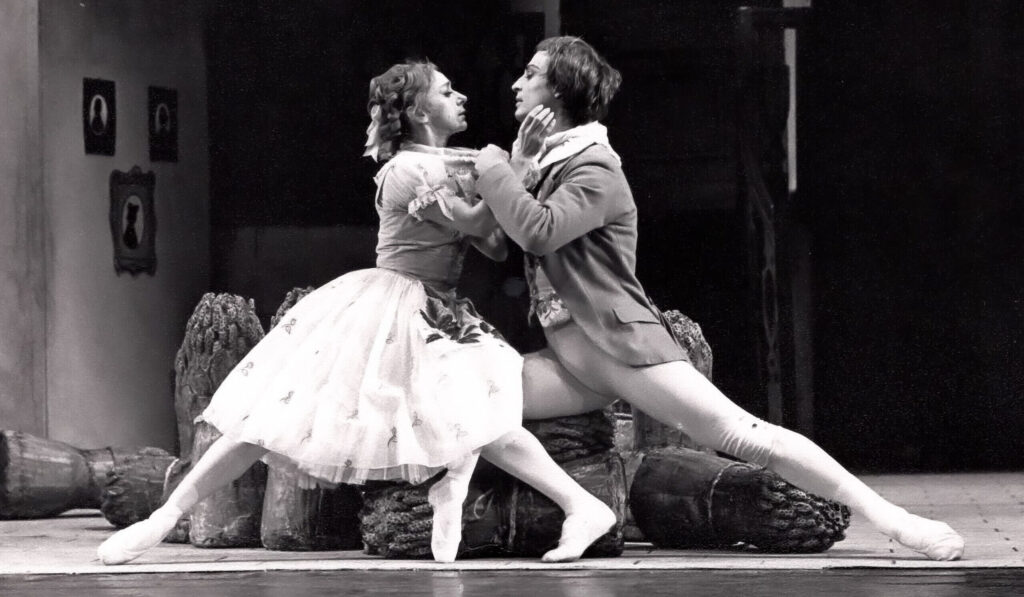
Brenda Last as Lise and Desmond Kelly as Colas in Ashton’s La Fille mal gardée, 1970 © Leslie E. Spatt / ArenaPAL
by Rachel Thomas, Communications Manager, The Frederick Ashton Foundation
“Girls, I want you to smile through your eyes, not through your teeth.”
Decades later, Brenda Last still remembers the correction exactly as Frederick Ashton gave it. It was a brief note, delivered to a handful of dancers preparing to perform Lise in La Fille mal gardée, but for Brenda it encapsulated everything about Ashton’s choreographic approach and creative vision: theatrical intelligence, emotional truth and absolute integrity of character.
Born in London in 1938, Brenda trained with Biddy Pinchard and then, for a year, at The Royal Ballet School. She went on to become one of the founder members of Western Theatre Ballet (later Scottish Ballet) before being spotted on stage by Ninette de Valois, who asked her to join the Royal Ballet Touring Company. Promoted to Principal just two years later, she danced all the major roles in the classical and dramatic repertory and was recognised, in particular, for her interpretations of Ashton’s work: “It had everything I could do: jump, turn, move fast”, she explains.
In addition to creating the highly contrasting roles of Terpsichore in his The Creatures of Prometheus (1970) and Black Berkshire Pig in the famous 1971 film Tales of Beatrix Potter, Ashton’s La Fille mal gardée (1960) became a cornerstone of Brenda’s career. “My first role was as a chicken, and then my next was Lise”, she says with a smile. She learnt the ballet in the studio alongside dancers including Doreen Wells, Shirley Graham and Nadia Nerina (on whom Ashton created Lise), under the watchful eye of “the most fantastic ballet master” Henry Legerton. By her own count, she went on to perform Lise 101 times—and that figure almost certainly understates the total, since it doesn’t include the touring performances she gave as a member of Ballet for All, with just a pianist and a few dancers, to audiences who had never seen ballet before.
For Brenda – a typical Ashtonian who was perfectly suited to the role’s challenging choreography – its appeal went far beyond technical display. “I liked Lise”, she says. “I never wanted her to be twee. She was a real country girl who had her feet firmly on the ground.” That authenticity was, she explains, something Ashton always instilled in his dancers. In rehearsals, it became clear that he didn’t want any aspects of the ballet played for easy laughs or sentimentality. Brenda recalls, for example, his precise words about the moment just before Lise’s famous mime sequence near the end of the ballet—in which she has been locked in the house by Widow Simone, and believes even Colas has gone off and left her:
“Ashton said to me: ‘Come down the stairs onto the stage, then walk away from the audience. You’ve got to have them with you so you could hear a pin drop’… He wanted real stillness and quiet before Lise’s optimism returns.”
Of course, being an Ashton ballet, La Fille mal gardée is not only a study in dramatic conviction, but also involves negotiating many theatrical challenges—including some memorably unpredictable props. The ribbons that feature prominently in the Act I pas de ruban, for example, “have a will of their own. You can rehearse as many times as you like… if they don’t want to behave, they won’t,” Brenda notes with feeling.“You just never know what’s going to happen”. It is a telling detail: beneath the sunlit charm of Fille lies a ballet of considerable technical and physical demands.
Yet what gives La Fille mal gardée its lasting appeal, she believes, is precisely the range of what it asks of its performers—and what it offers in turn to its audiences. Ashton’s years in the commercial theatre inspired a ballet that contains everything: “the Maypole, the pas de deux, the clog dance – which is essentially a tap dance – and then the storm, and then flying. You’ve got every single skill you can do in the theatre, all in that one ballet”, Brenda explains.
But spectacle alone is never the point. Ashton’s great gift, she says, was to make steps work as words; to use choreography in the service of storytelling rather than showmanship, so that even a viewer who has never seen ballet before understands exactly what is happening and why it matters. “People can forget that ballet should not just be gymnastics”, Brenda says. “You are entertainers, in the nicest possible way. You must never forget that.”
It is a lesson she has taken care to pass on, as a répétiteur and Ballet Mistress for Sadler’s Wells Royal Ballet, Artistic Director of Norwegian National Ballet and teacher to successive generations of dancers around the world. The lineage of those who worked directly with Ashton – who received his corrections firsthand – is, she acknowledges, diminishing. But what he created endures—his innate theatricality and unique gift for characterisation through movement brought to life by new generations of dancers. Speaking about The Royal Ballet, who are currently in the midst of run of La Fille mal gardée at the Royal Opera House, she is full of praise. “They are superb,” she says simply, and with the authority of someone who has experienced the ballet from every possible angle—from the rehearsal room, from the stage and from the stalls. “No doubt about it.”