
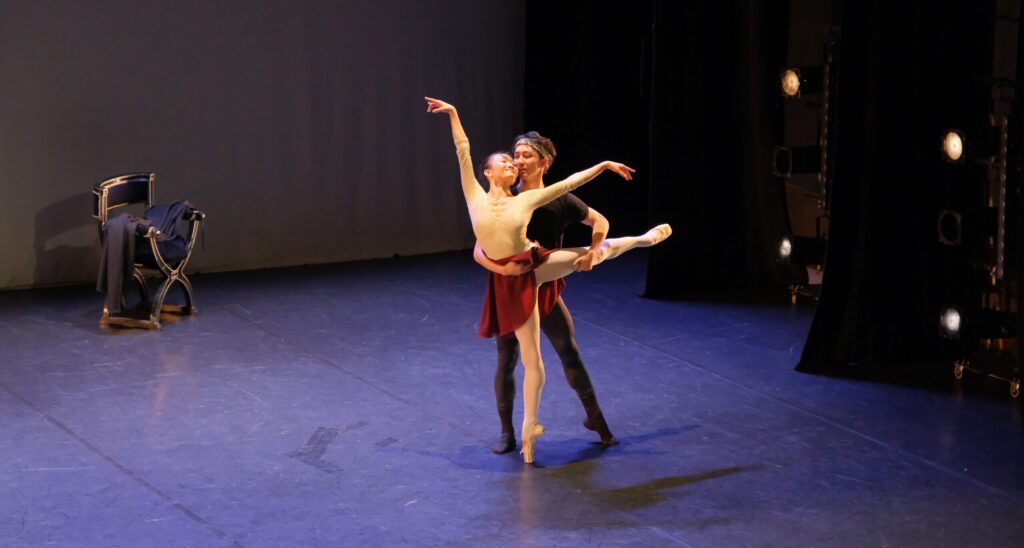
Yaoqian Shang and Riku Ito dancing Ashton’s Scène d’amour during an Ashton Rediscovered masterclass, January 2026 ©The Frederick Ashton Foundation. Ph Rachel Thomas.
by Jane Pritchard, taken from her introduction to the Ashton Rediscovered masterclass on 20 January 2026
Frederick Ashton’s Scene d’amour was a Raymonda-inspired pas de deux for Margot Fonteyn and Michael Somes created for the second of the annual gala matinees established to raise funds for the Royal Academy of Dancing, of which Fonteyn had become President in 1954.
The gala took place on 26 November 1959, and the divertissement briefly entered Fonteyn’s touring repertory for overseas performances. It was created shortly before Somes retired from principal roles (indeed it was Ashton’s last creation for their partnership), and Fonteyn also danced it on her Mediterranean tour in 1963—partnered by Ronald Hynd, who described it as heavenly dancing with Fonteyn.
Ashton’s ballet used the music by Alexander Glazunov (arranged by John Lanchbery) from Marius Petipa’s Raymonda (1898) and was inspired by Act 1 Scene 2, in which Raymonda has a vision of the crusader, Jean de Brienne, to whom she had been betrothed but had not met. Ashton, however, turned it into a duet for Raymonda and her Crusading knight about to return to the front. As Ashton’s biographer, David Vaughan, described it, ‘The dance depicted Raymonda’s passionate leave-taking of Jean de Brienne on the eve of his departure for the Crusades’.
Scene d’amour was Ashton’s only creation in 1959. For Fonteyn it comes between Ashton’s Ondine (1958) and Marguerite and Armand (1953), and in terms of his overall output it is a short ten-minute long divertissement between two contrasting long ballets, Ondine and La Fille mal gardée. Ashton had also turned to Glazunov when creating Birthday Offering in 1956, using a series of variations for his seven ballerinas drawn from music for The Seasons and Ruses d’amour.
Although he never choreographed a complete Raymonda it was a ballet that was of significance for Ashton. Apparently, the great Imperial ballerina Ashton’s friend Tamara Karsavina kept suggesting it as a possible multi-act ballet for him to consider staging, and he did go on to choreograph a Raymonda pas de deux for Svetlana Beriosova and Donald MacLeary in 1962. However, Ashton was unhappy with the ballet’s narrative, described by Petipa scholar Nadine Meisner as ‘narratively thin and geographically convoluted’ and more bluntly by the critic Clement Crisp as ‘idiotic’. Ashton must have delighted when Rudolf Nureyev chose to stage a version for The Royal Ballet removing any need for him to do so.
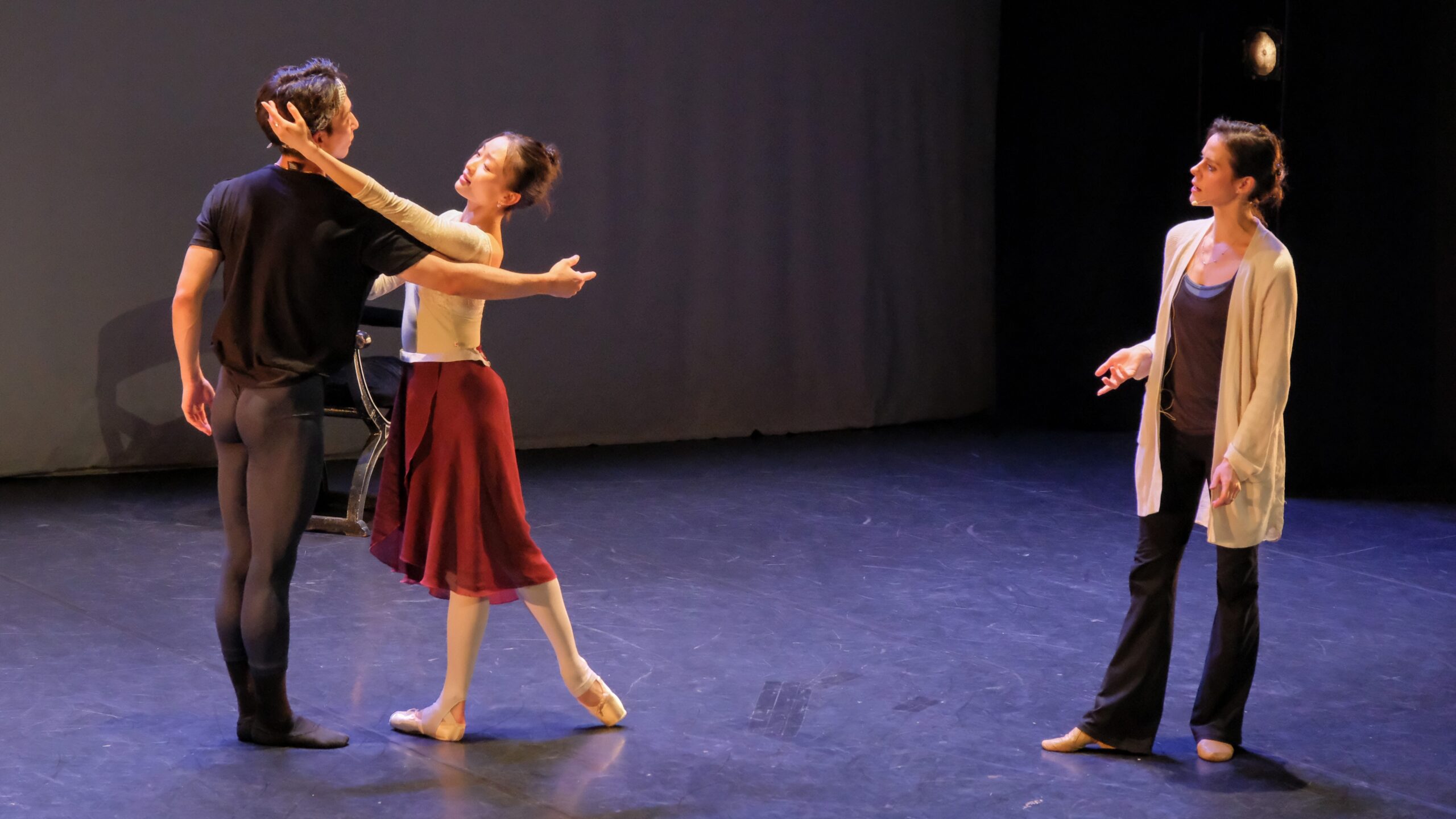
Samara Downs coaching Yaoqian Shang and Riku Ito in Ashton’s Scène d’amour during an Ashton Rediscovered masterclass, January 2026 ©The Frederick Ashton Foundation. Ph Rachel Thomas.
Petipa’s Raymonda had a narrative inspired by the Crusades that fitted with late nineteenth-century fascination with romanticised medieval culture. The name, Jean de Brienne, was taken from a crusading hero of thirteenth century who became John of Jerusalem. But its strength and reason for survival is its series of classical and indeed character variations. As the choreography was school of Petipa, Sarah Woodcock, Somes’ biographer, described the duet as ‘Ashtonia Petipaesque’. The Observer noted that it was a ‘kind of drifting pas de deux whose fragile bones [Fonteyn] can clothe with such a breathing body of interpretation.’ When Fonteyn was asked about the ballet, she summed it up ‘it’s the story of my life. Saying goodbye to Tito’. (Tito being Roberto Arias, Fonteyn’s husband—then frequently away on his political missions in Panama.)
Raymonda was one of the two ballets Ashton specifically remembered seeing when he watched Anna Pavlova dancing at the Municipal Theatre in Lima Peru. As it was only performed on 8 and 21 October 1918 (and as Pavlova only toured her two-act Raymonda in the Americas) Ashton must have seen it on one of those dates. He was mesmerised by Pavlova: ‘diagonal bourrées along a path marked out by roses and all the carry on with her hands and eyes’. As he said he was ‘injected by the poison’, wanting to be Pavlova, while his friend, Guy Watson, focussed on Pavlova’s partner, Alexander Volinine, in his Crusader costume. Although Pavlova’s Raymonda was staged by Ivan Clustine it would have included much of Petipa’s original production, meaning this was the start of Ashton’s fascination with Petipa’s choreography as well as his obsession with the ballerina.
Scene d’amour was revived on 5 March 1973 for The Royal Ballet New Group at a time when classical pas de deux were being added to programmes in which more modern ballets were presented. It was first danced by Vyvyan Lorrayne and Barry McGrath at Theatre Royal, Norwich but seems to have been more successful when danced by Patricia Ruanne and Desmond Kelly at Sadler’s Wells. Ashton provided the succinct programme note ‘A Crusader off to the wars parts from his beloved’. It was at this time that Scene d’amour was notated by Liz Cunliffe, which provided the key resource for the reconstruction of the pas de deux.
Clearly some changes were introduced. While initially Fonteyn began the ballet on steps looking out longingly, here Raymonda began sitting in reverie on a ‘medieval’ chair which also became somewhere Brienne’s cloak, an effective prop in the ballet, could be placed. The costumes, still credited to Leslie Hurry, were simplified. Raymonda’s dress was less diaphanous with a wider belt at the waist and three slashes in long fitted sleeves. (Fonteyn’s was more like that worn by Pavlova, it survives in the RBO collection.) The headdress, too, was simplified. Jean de Brienne’s formerly asymmetrical costume became a tunic with heraldic decoration. Reviewing the revival, which had 22 performances, John Percival in Dance and Dancers acknowledged that Ruanne and Kelly ‘danced it with a rapt expressiveness which matches the ardour of the choreography and the warm richness of the Glazunov music. It is touching to be reminded so vividly of the individual qualities of Fonteyn which Ashton has embodied in this dance: tenderness, grace, simplicity and depth.’
Jane Pritchard MBE is Curator of Dance for the Victoria and Albert Museum, London, and one of the most distinguished British historians of dance. She has held positions as archivist of Rambert Dance Company and English National Ballet, and has written widely on the Ballets Russes and on 19th- and 20th-century dance.
Watch the Scène d’amour Ashton Rediscovered: masterclass on YouTube
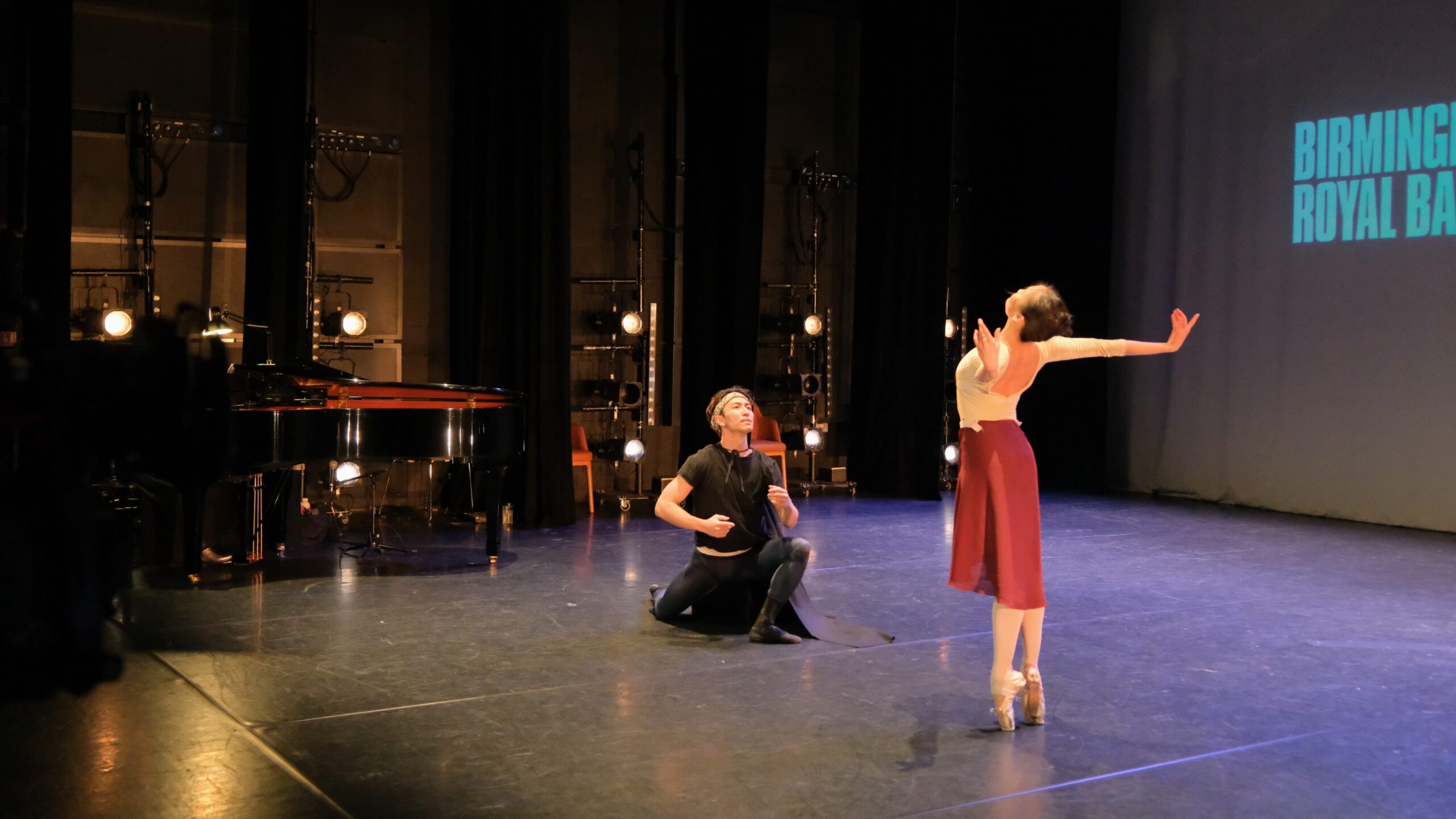
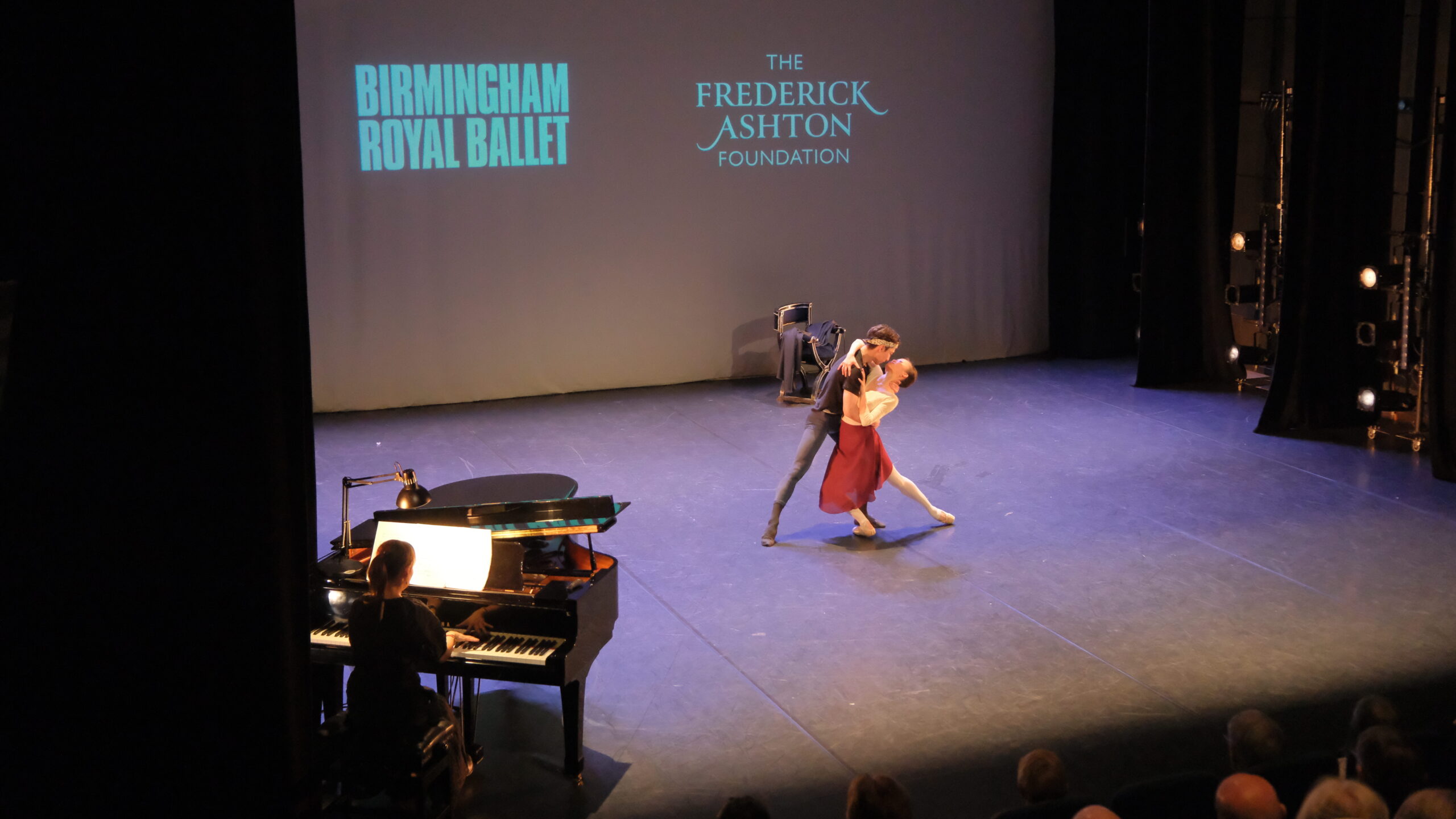
Yaoqian Shang and Riku Ito dancing Ashton’s Scène d’amour during an Ashton Rediscovered masterclass, January 2026 ©The Frederick Ashton Foundation. Ph Rachel Thomas.